Note
Go to the end to download the full example code.
Layer Normalization
In this tutorial, you will write a high-performance layer normalization kernel that runs faster than the PyTorch implementation.
In doing so, you will learn about:
Implementing backward pass in Triton.
Implementing parallel reduction in Triton.
Motivations
The LayerNorm operator was first introduced in [BA2016] as a way to improve the performance of sequential models (e.g., Transformers) or neural networks with small batch size. It takes a vector \(x\) as input and produces a vector \(y\) of the same shape as output. The normalization is performed by subtracting the mean and dividing by the standard deviation of \(x\). After the normalization, a learnable linear transformation with weights \(w\) and biases \(b\) is applied. The forward pass can be expressed as follows:
where \(\epsilon\) is a small constant added to the denominator for numerical stability. Let’s first take a look at the forward pass implementation.
import torch

import triton
import triton.language as tl

try:
    # This is https://github.com/NVIDIA/apex, NOT the apex on PyPi, so it
    # should not be added to extras_require in setup.py.
    import apex
    HAS_APEX = True
except ModuleNotFoundError:
    HAS_APEX = False


@triton.jit
def _layer_norm_fwd_fused(
    X,  # pointer to the input
    Y,  # pointer to the output
    W,  # pointer to the weights
    B,  # pointer to the biases
    Mean,  # pointer to the mean
    Rstd,  # pointer to the 1/std
    stride,  # how much to increase the pointer when moving by 1 row
    N,  # number of columns in X
    eps,  # epsilon to avoid division by zero
    BLOCK_SIZE: tl.constexpr,
):
    # Map the program id to the row of X and Y it should compute.
    row = tl.program_id(0)
    Y += row * stride
    X += row * stride
    # Compute mean
    mean = 0
    _mean = tl.zeros([BLOCK_SIZE], dtype=tl.float32)
    for off in range(0, N, BLOCK_SIZE):
        cols = off + tl.arange(0, BLOCK_SIZE)
        a = tl.load(X + cols, mask=cols < N, other=0.).to(tl.float32)
        _mean += a
    mean = tl.sum(_mean, axis=0) / N
    # Compute variance
    _var = tl.zeros([BLOCK_SIZE], dtype=tl.float32)
    for off in range(0, N, BLOCK_SIZE):
        cols = off + tl.arange(0, BLOCK_SIZE)
        x = tl.load(X + cols, mask=cols < N, other=0.).to(tl.float32)
        x = tl.where(cols < N, x - mean, 0.)
        _var += x * x
    var = tl.sum(_var, axis=0) / N
    rstd = 1 / tl.sqrt(var + eps)
    # Write mean / rstd
    tl.store(Mean + row, mean)
    tl.store(Rstd + row, rstd)
    # Normalize and apply linear transformation
    for off in range(0, N, BLOCK_SIZE):
        cols = off + tl.arange(0, BLOCK_SIZE)
        mask = cols < N
        w = tl.load(W + cols, mask=mask)
        b = tl.load(B + cols, mask=mask)
        x = tl.load(X + cols, mask=mask, other=0.).to(tl.float32)
        x_hat = (x - mean) * rstd
        y = x_hat * w + b
        # Write output
        tl.store(Y + cols, y, mask=mask)
Backward pass
The backward pass for the layer normalization operator is a bit more involved than the forward pass. Let \(\hat{x}\) be the normalized inputs \(\frac{ x - \text{E}[x] }{ \sqrt{\text{Var}(x) + \epsilon} }\) before the linear transformation, the Vector-Jacobian Products (VJP) \(\nabla_{x}\) of \(x\) are given by:
where \(\odot\) denotes the element-wise multiplication, \(\cdot\) denotes the dot product, and \(\sigma\) is the standard deviation. \(c_1\) and \(c_2\) are intermediate constants that improve the readability of the following implementation.
For the weights \(w\) and biases \(b\), the VJPs \(\nabla_{w}\) and \(\nabla_{b}\) are more straightforward:
Since the same weights \(w\) and biases \(b\) are used for all rows in the same batch, their gradients need to sum up. To perform this step efficiently, we use a parallel reduction strategy: each kernel instance accumulates partial \(\nabla_{w}\) and \(\nabla_{b}\) across certain rows into one of \(\text{GROUP_SIZE_M}\) independent buffers. These buffers stay in the L2 cache and then are further reduced by another function to compute the actual \(\nabla_{w}\) and \(\nabla_{b}\).
Let the number of input rows \(M = 4\) and \(\text{GROUP_SIZE_M} = 2\), here’s a diagram of the parallel reduction strategy for \(\nabla_{w}\) (\(\nabla_{b}\) is omitted for brevity):
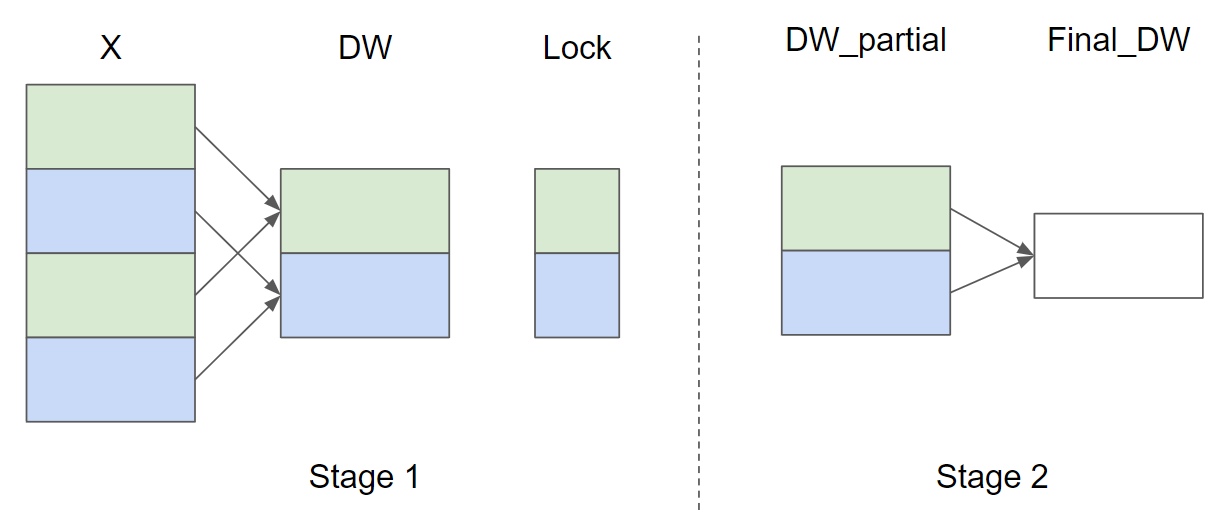
In Stage 1, the rows of X that have the same color share the same buffer and thus a lock is used to ensure that only one kernel instance writes to the buffer at a time.
In Stage 2, the buffers are further reduced to compute the final \(\nabla_{w}\) and \(\nabla_{b}\).
In the following implementation, Stage 1 is implemented by the function _layer_norm_bwd_dx_fused and Stage 2 is implemented by the function _layer_norm_bwd_dwdb.
@triton.jit
def _layer_norm_bwd_dx_fused(DX,  # pointer to the input gradient
                             DY,  # pointer to the output gradient
                             DW,  # pointer to the partial sum of weights gradient
                             DB,  # pointer to the partial sum of biases gradient
                             X,  # pointer to the input
                             W,  # pointer to the weights
                             B,  # pointer to the biases
                             Mean,  # pointer to the mean
                             Rstd,  # pointer to the 1/std
                             Lock,  # pointer to the lock
                             stride,  # how much to increase the pointer when moving by 1 row
                             N,  # number of columns in X
                             eps,  # epsilon to avoid division by zero
                             GROUP_SIZE_M: tl.constexpr, BLOCK_SIZE_N: tl.constexpr):
    # Map the program id to the elements of X, DX, and DY it should compute.
    row = tl.program_id(0)
    cols = tl.arange(0, BLOCK_SIZE_N)
    mask = cols < N
    X += row * stride
    DY += row * stride
    DX += row * stride
    # Offset locks and weights/biases gradient pointer for parallel reduction
    lock_id = row % GROUP_SIZE_M
    Lock += lock_id
    Count = Lock + GROUP_SIZE_M
    DW = DW + lock_id * N + cols
    DB = DB + lock_id * N + cols
    # Load data to SRAM
    x = tl.load(X + cols, mask=mask, other=0).to(tl.float32)
    dy = tl.load(DY + cols, mask=mask, other=0).to(tl.float32)
    w = tl.load(W + cols, mask=mask).to(tl.float32)
    mean = tl.load(Mean + row)
    rstd = tl.load(Rstd + row)
    # Compute dx
    xhat = (x - mean) * rstd
    wdy = w * dy
    xhat = tl.where(mask, xhat, 0.)
    wdy = tl.where(mask, wdy, 0.)
    c1 = tl.sum(xhat * wdy, axis=0) / N
    c2 = tl.sum(wdy, axis=0) / N
    dx = (wdy - (xhat * c1 + c2)) * rstd
    # Write dx
    tl.store(DX + cols, dx, mask=mask)
    # Accumulate partial sums for dw/db
    partial_dw = (dy * xhat).to(w.dtype)
    partial_db = (dy).to(w.dtype)
    while tl.atomic_cas(Lock, 0, 1) == 1:
        pass
    count = tl.load(Count)
    # First store doesn't accumulate
    if count == 0:
        tl.atomic_xchg(Count, 1)
    else:
        partial_dw += tl.load(DW, mask=mask)
        partial_db += tl.load(DB, mask=mask)
    tl.store(DW, partial_dw, mask=mask)
    tl.store(DB, partial_db, mask=mask)
    # Release the lock
    tl.atomic_xchg(Lock, 0)


@triton.jit
def _layer_norm_bwd_dwdb(DW,  # pointer to the partial sum of weights gradient
                         DB,  # pointer to the partial sum of biases gradient
                         FINAL_DW,  # pointer to the weights gradient
                         FINAL_DB,  # pointer to the biases gradient
                         M,  # GROUP_SIZE_M
                         N,  # number of columns
                         BLOCK_SIZE_M: tl.constexpr, BLOCK_SIZE_N: tl.constexpr):
    # Map the program id to the elements of DW and DB it should compute.
    pid = tl.program_id(0)
    cols = pid * BLOCK_SIZE_N + tl.arange(0, BLOCK_SIZE_N)
    dw = tl.zeros((BLOCK_SIZE_M, BLOCK_SIZE_N), dtype=tl.float32)
    db = tl.zeros((BLOCK_SIZE_M, BLOCK_SIZE_N), dtype=tl.float32)
    # Iterate through the rows of DW and DB to sum the partial sums.
    for i in range(0, M, BLOCK_SIZE_M):
        rows = i + tl.arange(0, BLOCK_SIZE_M)
        mask = (rows[:, None] < M) & (cols[None, :] < N)
        offs = rows[:, None] * N + cols[None, :]
        dw += tl.load(DW + offs, mask=mask, other=0.)
        db += tl.load(DB + offs, mask=mask, other=0.)
    # Write the final sum to the output.
    sum_dw = tl.sum(dw, axis=0)
    sum_db = tl.sum(db, axis=0)
    tl.store(FINAL_DW + cols, sum_dw, mask=cols < N)
    tl.store(FINAL_DB + cols, sum_db, mask=cols < N)
Benchmark
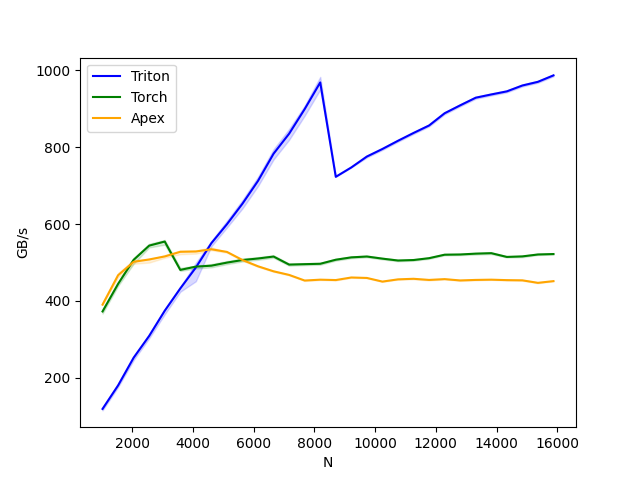
We can now compare the performance of our kernel against that of PyTorch.
Here we focus on inputs that have Less than 64KB per feature.
Specifically, one can set 'mode': 'backward' to benchmark the backward pass.
class LayerNorm(torch.autograd.Function):

    @staticmethod
    def forward(ctx, x, normalized_shape, weight, bias, eps):
        # allocate output
        y = torch.empty_like(x)
        # reshape input data into 2D tensor
        x_arg = x.reshape(-1, x.shape[-1])
        M, N = x_arg.shape
        mean = torch.empty((M, ), dtype=torch.float32, device='cuda')
        rstd = torch.empty((M, ), dtype=torch.float32, device='cuda')
        # Less than 64KB per feature: enqueue fused kernel
        MAX_FUSED_SIZE = 65536 // x.element_size()
        BLOCK_SIZE = min(MAX_FUSED_SIZE, triton.next_power_of_2(N))
        if N > BLOCK_SIZE:
            raise RuntimeError("This layer norm doesn't support feature dim >= 64KB.")
        # heuristics for number of warps
        num_warps = min(max(BLOCK_SIZE // 256, 1), 8)
        # enqueue kernel
        _layer_norm_fwd_fused[(M, )](  #
            x_arg, y, weight, bias, mean, rstd,  #
            x_arg.stride(0), N, eps,  #
            BLOCK_SIZE=BLOCK_SIZE, num_warps=num_warps, num_ctas=1)
        ctx.save_for_backward(x, weight, bias, mean, rstd)
        ctx.BLOCK_SIZE = BLOCK_SIZE
        ctx.num_warps = num_warps
        ctx.eps = eps
        return y

    @staticmethod
    def backward(ctx, dy):
        x, w, b, m, v = ctx.saved_tensors
        # heuristics for amount of parallel reduction stream for DW/DB
        N = w.shape[0]
        GROUP_SIZE_M = 64
        if N <= 8192: GROUP_SIZE_M = 96
        if N <= 4096: GROUP_SIZE_M = 128
        if N <= 1024: GROUP_SIZE_M = 256
        # allocate output
        locks = torch.zeros(2 * GROUP_SIZE_M, dtype=torch.int32, device='cuda')
        _dw = torch.empty((GROUP_SIZE_M, w.shape[0]), dtype=x.dtype, device=w.device)
        _db = torch.empty((GROUP_SIZE_M, w.shape[0]), dtype=x.dtype, device=w.device)
        dw = torch.empty((w.shape[0], ), dtype=w.dtype, device=w.device)
        db = torch.empty((w.shape[0], ), dtype=w.dtype, device=w.device)
        dx = torch.empty_like(dy)
        # enqueue kernel using forward pass heuristics
        # also compute partial sums for DW and DB
        x_arg = x.reshape(-1, x.shape[-1])
        M, N = x_arg.shape
        _layer_norm_bwd_dx_fused[(M, )](  #
            dx, dy, _dw, _db, x, w, b, m, v, locks,  #
            x_arg.stride(0), N, ctx.eps,  #
            BLOCK_SIZE_N=ctx.BLOCK_SIZE,  #
            GROUP_SIZE_M=GROUP_SIZE_M,  #
            num_warps=ctx.num_warps)
        grid = lambda meta: [triton.cdiv(N, meta['BLOCK_SIZE_N'])]
        # accumulate partial sums in separate kernel
        _layer_norm_bwd_dwdb[grid](
            _dw, _db, dw, db, GROUP_SIZE_M, N,  #
            BLOCK_SIZE_M=32,  #
            BLOCK_SIZE_N=128, num_ctas=1)
        return dx, None, dw, db, None


layer_norm = LayerNorm.apply


def test_layer_norm(M, N, dtype, eps=1e-5, device='cuda'):
    # create data
    x_shape = (M, N)
    w_shape = (x_shape[-1], )
    weight = torch.rand(w_shape, dtype=dtype, device='cuda', requires_grad=True)
    bias = torch.rand(w_shape, dtype=dtype, device='cuda', requires_grad=True)
    x = -2.3 + 0.5 * torch.randn(x_shape, dtype=dtype, device='cuda')
    dy = .1 * torch.randn_like(x)
    x.requires_grad_(True)
    # forward pass
    y_tri = layer_norm(x, w_shape, weight, bias, eps)
    y_ref = torch.nn.functional.layer_norm(x, w_shape, weight, bias, eps).to(dtype)
    # backward pass (triton)
    y_tri.backward(dy, retain_graph=True)
    dx_tri, dw_tri, db_tri = [_.grad.clone() for _ in [x, weight, bias]]
    x.grad, weight.grad, bias.grad = None, None, None
    # backward pass (torch)
    y_ref.backward(dy, retain_graph=True)
    dx_ref, dw_ref, db_ref = [_.grad.clone() for _ in [x, weight, bias]]
    # compare
    assert torch.allclose(y_tri, y_ref, atol=1e-2, rtol=0)
    assert torch.allclose(dx_tri, dx_ref, atol=1e-2, rtol=0)
    assert torch.allclose(db_tri, db_ref, atol=1e-2, rtol=0)
    assert torch.allclose(dw_tri, dw_ref, atol=1e-2, rtol=0)


@triton.testing.perf_report(
    triton.testing.Benchmark(
        x_names=['N'],
        x_vals=[512 * i for i in range(2, 32)],
        line_arg='provider',
        line_vals=['triton', 'torch'] + (['apex'] if HAS_APEX else []),
        line_names=['Triton', 'Torch'] + (['Apex'] if HAS_APEX else []),
        styles=[('blue', '-'), ('green', '-'), ('orange', '-')],
        ylabel='GB/s',
        plot_name='layer-norm-backward',
        args={'M': 4096, 'dtype': torch.float16, 'mode': 'backward'},
    ))
def bench_layer_norm(M, N, dtype, provider, mode='backward', eps=1e-5, device='cuda'):
    # create data
    x_shape = (M, N)
    w_shape = (x_shape[-1], )
    weight = torch.rand(w_shape, dtype=dtype, device='cuda', requires_grad=True)
    bias = torch.rand(w_shape, dtype=dtype, device='cuda', requires_grad=True)
    x = -2.3 + 0.5 * torch.randn(x_shape, dtype=dtype, device='cuda')
    dy = .1 * torch.randn_like(x)
    x.requires_grad_(True)
    quantiles = [0.5, 0.2, 0.8]
    # utility functions
    if provider == 'triton':

        def y_fwd():
            return layer_norm(x, w_shape, weight, bias, eps)  # noqa: F811, E704

    if provider == 'torch':

        def y_fwd():
            return torch.nn.functional.layer_norm(x, w_shape, weight, bias, eps)  # noqa: F811, E704

    if provider == 'apex':
        apex_layer_norm = apex.normalization.FusedLayerNorm(w_shape).to(x.device).to(x.dtype)

        def y_fwd():
            return apex_layer_norm(x)  # noqa: F811, E704

    # forward pass
    if mode == 'forward':
        gbps = lambda ms: 2 * x.numel() * x.element_size() / ms * 1e-6
        ms, min_ms, max_ms = triton.testing.do_bench(y_fwd, quantiles=quantiles, rep=500)
    # backward pass
    if mode == 'backward':

        def gbps(ms):
            return 3 * x.numel() * x.element_size() / ms * 1e-6  # noqa: F811, E704

        y = y_fwd()
        ms, min_ms, max_ms = triton.testing.do_bench(lambda: y.backward(dy, retain_graph=True), quantiles=quantiles,
                                                     grad_to_none=[x], rep=500)
    return gbps(ms), gbps(max_ms), gbps(min_ms)


test_layer_norm(1151, 8192, torch.float16)
bench_layer_norm.run(save_path='.', print_data=True)
layer-norm-backward:
          N      Triton       Torch        Apex
0    1024.0  118.724635  372.363633  390.095241
1    1536.0  179.824387  444.144584  466.632925
2    2048.0  252.061538  506.721668  501.551037
3    2560.0  308.743716  543.716805  507.768606
4    3072.0  374.253805  554.345889  515.580429
5    3584.0  432.241202  480.536326  527.705508
6    4096.0  486.653476  489.074621  528.516116
7    4608.0  550.208948  491.520008  534.260858
8    5120.0  599.414623  499.512174  527.381977
9    5632.0  652.985493  506.247199  506.247199
10   6144.0  712.347810  510.228394  489.887055
11   6656.0  783.058838  515.303221  476.847776
12   7168.0  835.106808  494.344826  467.478250
13   7680.0  899.121934  495.483858  452.874677
14   8192.0  968.512300  496.484863  455.111110
15   8704.0  722.823558  507.029134  454.121729
16   9216.0  747.243211  513.187943  460.800012
17   9728.0  775.654504  515.390744  459.590527
18  10240.0  795.339817  509.875515  450.109870
19  10752.0  816.607619  504.986310  455.915192
20  11264.0  836.953598  506.247199  457.421306
21  11776.0  856.436338  511.074123  454.379406
22  12288.0  888.289167  520.126975  456.520144
23  12800.0  908.875706  520.677957  453.097357
24  13312.0  928.744186  522.893621  454.463728
25  13824.0  937.220368  524.132711  455.111098
26  14336.0  945.230752  514.295986  453.910285
27  14848.0  960.517515  515.704759  453.374052
28  15360.0  970.105232  520.677982  446.836366
29  15872.0  986.860104  521.819157  451.336480
References
Jimmy Lei Ba and Jamie Ryan Kiros and Geoffrey E. Hinton, “Layer Normalization”, Arxiv 2016
Total running time of the script: (0 minutes 44.028 seconds)